_svg.png)

ISO 23875 Cab Air Quality in Canada
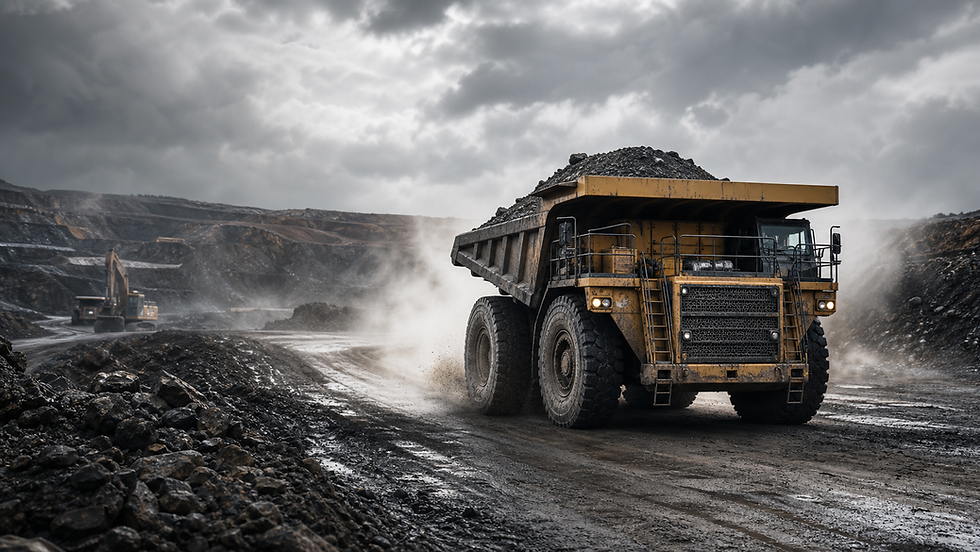
Every operator deserves clean, breathable air in the cab for a full shift, and every site owner deserves to be able to prove their cabs deliver it. On Canadian mine and industrial sites, that is an achievable standard. It starts with understanding what the cab is actually up against.
A haul truck in a Saskatchewan potash operation, a surface coal loader near Grande Cache, Alberta, or a hard-rock drill rig in northern BC all pull in ambient air, and on these sites that air carries respirable crystalline silica. The stakes are real. Long-term exposure causes silicosis, a serious and irreversible lung disease, and an operator can breathe it in for years before feeling a thing. The encouraging part is that this is controllable. With the right cab air system, you keep the dust out, you measure that it is staying out, and you keep the records that prove it.
That is where ISO 23875 becomes a useful conversation.
What is ISO 23875 and why does it apply to Canadian sites?
ISO 23875 is an international standard published in 2021 and amended in 2022. Its full title is Mining and earth-moving machinery: air quality control systems for operator enclosures. In plain language, it defines what a cab air system must do, how to measure whether it is doing it, and how to keep it doing it over time.
ISO 23875 is not a Canadian regulation the way the Alberta Occupational Health and Safety Act or WorkSafeBC's Chemical Agents regulation are law. It is a performance standard. The distinction matters because Canadian provincial regulators and the Canada Labour Code Part II require employers to control worker exposure to respirable silica below set limits. In Alberta and British Columbia that limit is 0.025 mg/m3 as an eight-hour time-weighted average, and most Canadian jurisdictions align with the same ACGIH threshold. How you achieve that is largely left to the employer. ISO 23875 tells you how to do it on mobile equipment in a way that is documented, measurable, and defensible.
When a WCB inspector in Alberta or a WorkSafeBC officer asks how your cab air system controls silica exposure, we think it works is not an answer. A system built and commissioned to ISO 23875 requirements, with recorded pressure levels and monitored air quality data, is.
What does ISO 23875 actually require?
The standard breaks its requirements into four areas: performance, engineering design, monitoring and alarms, and maintenance. Here is what each means in practice.
Performance means the cab air system must hold positive cabin pressure, between 20 Pa and 200 Pa above ambient, during normal operation. Positive pressure is the mechanism that prevents contaminated outside air from leaking in through door seals, cable penetrations, and floor gaps every time the cab flexes. The standard also sets a particulate decay limit: if you introduce dust inside the cab, the system must reduce it to 25 micrograms per cubic metre or below within 120 seconds. Sustained CO2 levels, which indicate whether the operator is getting enough fresh air, must not rise more than 400 parts per million above the ambient outdoor CO2 concentration.
Engineering design requirements address how the system is built. External air must pass through high-efficiency filtration before entering the cab. The standard notes that filter efficiencies greater than 94 percent at 0.3 to 0.5 microns have proven effective, and it requires that any mounting hardware attach to existing structure without modifying the cab's rollover protection structure (ROPS) or falling object protection structure (FOPS). Modifying those structures without manufacturer sign-off is a separate safety violation.
Monitoring and alarm requirements specify that the system must continuously measure cabin pressure and CO2, compensate for altitude and temperature variation, and alert the operator when thresholds are exceeded. Altitude compensation matters in Alberta foothills operations and high-elevation BC mine sites, where uncorrected sensors drift. Alarm thresholds are configurable, set to the level that suits each operation.
Maintenance requirements are about traceability. Filter changes must be documented with batch numbers, production dates, and efficiency classifications. The system must be designed for tool-free access to filters where possible.
Who carries the compliance obligation in Canada?
This is the question site owners sometimes try to sidestep. The short answer is that the obligation sits with the employer, which on a contract mine site means both the mine owner and the contractor operating the equipment, depending on how their agreements are structured.
Under provincial occupational health and safety legislation across Canada, the employer must assess worker exposure to hazardous substances and implement controls sufficient to keep exposure below the regulatory limit. CAREX Canada estimates that approximately 429,000 workers in Canada are occupationally exposed to silica, and heavy equipment operators are among the largest exposed groups. The burden to control that exposure is not the operator's to carry. It belongs to the organization that puts the operator in the cab.
That means a fleet manager in Fort McMurray, a health and safety director for a Saskatchewan potash producer, or a mine site owner in northern BC needs to be able to demonstrate that the cabs in their fleet are actually performing. Not just that filters have been changed, but that cabin pressure was maintained, that CO2 stayed within limits, and that records exist to prove it. ISO 23875 provides the framework for building that demonstration.
What does a system that meets ISO 23875 actually look like?
A compliant cab air system has three physical components working together: a pressurizer that draws outside air through a high-efficiency filter and pushes it into the cab at positive pressure; a recirculation filter that cleans air already inside the cab; and a controller that monitors cabin pressure and CO2 continuously, displaying readings to the operator and triggering alarms when either goes out of range.
Lineva is a Canadian distributor for BreatheSafe cab pressurization and monitoring systems. The systems Lineva supplies and commissions are built around HEPA H14 filtration, rated at 99.997 percent efficiency and tested to EN1822, capturing particles down to 0.1 microns. That is materially better than the H13 grade many systems use, and it matters because mine sites in Alberta and BC frequently run silica concentrations well above what a marginal filter can handle. The BreatheSafe pressurizer holds cabin pressure comfortably above the 20 Pa minimum, with a configurable setpoint, commonly between 20 and 50 Pa, tuned to the machine and the conditions.
The monitoring controller measures cabin pressure and CO2 continuously, compensates for altitude and temperature, and triggers configurable alarms set to each site's requirements. Commissioning is documented through a structured process that records baseline pressure, decay performance, and filter details for each machine. That commissioning record is the proof file a site owner needs if a regulator, insurer, or WCB auditor asks how the cab air system was verified.
Why does the standard exist and what has changed recently?
Prior to ISO 23875, cab air requirements across the mining industry were inconsistent. Some factory-fitted HVAC systems were designed primarily for operator comfort, not contaminant control. BreatheSafe notes it has not found an OEM air filtration system fitted as standard that meets ISO 23875. The gap between what a comfort-focused system delivers and what the standard requires can be significant. A system commissioned to ISO 23875 performance requirements should cut a dust spike inside the cab back to safe levels in under two minutes.
The 2022 amendment to ISO 23875 tightened several monitoring requirements, particularly around CO2 sensor specifications and alarm clarity. These changes reflected real-world experience with operators working in high-altitude sites and enclosed spaces, where CO2 can build up and dull alertness before it reaches levels most people associate with danger.
How does this connect to Canadian regulatory pressure right now?
Silica regulation in Canada is tightening. Several provinces have moved or are moving toward explicit requirements for documented engineering controls on mobile equipment, rather than accepting respiratory protective equipment as a primary control. WorkSafeBC's occupational disease strategy, Alberta's OHS framework, and federal Canada Labour Code Part II workplace health requirements all establish a hierarchy of controls that places engineering solutions above PPE. A cab pressurization system that meets ISO 23875 is an engineering control. A dust mask is not.
The practical effect for Canadian mine operators is that demonstrated cab air performance is becoming a baseline expectation in contractor qualification. If your fleet can show measured, recorded cab air data, you are ready for the audits, tenders, and incident reviews when they come.
What does Lineva do differently for Canadian customers?
Lineva approaches cab air as a diagnostic problem before it becomes an installation project. Sites across Alberta's oil sands, Saskatchewan's potash fields, and BC's hard rock sector carry different dust profiles, equipment fleets, and regulatory contexts. A solution for a Cat 785 haul truck on a surface coal site is not the same as a solution for a Komatsu excavator in a silica-heavy aggregate pit.
Lineva diagnoses the dust problem first, then sizes and specifies the right BreatheSafe system for the application. Commissioning is carried out locally, with documentation provided in a format that supports the site's own OHS record-keeping requirements.
That last point matters. A commissioning record created offshore by a supplier on another continent does not carry the same weight in a WCB Alberta audit as locally documented, in-person commissioning with records tied to specific machine serial numbers and site addresses.
If your site runs mobile equipment in dusty conditions, the starting point is a clear picture of what your cabs are actually doing. Not what the OEM says the cab should do, but what it measurably does on your site under your conditions.
Lineva can walk through that assessment, identify which machines present the highest exposure risk, and specify what a compliant system looks like for each application. The goal is clean, breathable, monitored air in every operator cab, with the records to prove it.
Got a dust problem? Tell us where it's a problem and we'll fix it.
Contact Lineva: 587-407-2870 | www.lineva-air-solutions.ca